


Check out this Tadpol Trike electric conversion story here
Grin Technologies is dedicated to building the best eBike parts for converting your bicycle (or tadpole tricycle) to an Ebike. We enable our community to build their dream eBike. Find out more about Grin Technologies on our YouTube: https://www.youtube.com/@GrinTechnologies
This article goes over the most common questions our customers ask when planning their Recumbent Tricycle eBike conversion.
Recumbent trikes can be readily converted into electric assist to unlock a host of benefits from assistance with hill climbing to regenerative braking on the downhill. Electrification is most typically done with either a rear hub motor on the back wheel or a mid-drive motor on the crankset. However more advanced installers also have the option to electrify one or both front wheels of a tadpole trike which is ideal for certain scenarios.
Is a rear hub motor or mid-drive motor better for a recumbent trike?
You will find strong advocates of both hub motors and mid-drive solutions online, but at Grin we believe that for most riders the benefits of a direct-drive hub motor will outweigh the advantages of a mid-drive kit.
A mid-drive motor on a tadpole trike will put all of the motor power through the pedal drivetrain. The primary advantage of mid-drive motors is that you can get excellent hill climbing torque at low speeds when climbing in an easy gear. But it comes with numerous downsides too:
- Accelerated wear of the chain, chainrings, and drivetrain components as now both motor and pedal power has go to through the same transmission.
- No option for regenerative braking, resulting in more rapid wear of brake pads and less efficient use of energy when going up and down hills
- No redundancy in propulsion, a mechanical failure on the drivetrain will block both the human pedaling and electric motor propulsion (e.g. broken chain, tangled derailleur).
With Grin’s rear All-Axle hub motor conversion, you get a reasonably powerful motor with no moving parts that runs fully independent of the pedal drivetrain. On a trike, there is a further advantage that the direct drive motor can also be run backwards for a reverse function.
- Almost eliminate brake pad wear through regenerative braking
- Improved range in hilly regions or areas with stop and go traffic as a result of the energy recapture
- Ability to use bidirectional throttle for reverse power control, permitting easy 3 point turns and navigation in tight quarters
- Greatly reduced wear of pedal transmission, as the hub motor takes up the majority of the propulsion stress
Recommend All-Axle Motor: If you use the trike regularly for commuting and exploring primarily paved roads, the rear hub motor will be your best candidate. You will get great average motor efficiency, total silence, extended longevity of the wear points (drivetrain and gears) resulting in a lower maintenance vehicle. In hilly terrain, the regen braking can easily add 10-20% to your total range.
Recommend MidDrive Motor: If you ride offroad or in technical terrain where you are often climbing at very low speeds, the mid-drive motor will achieve better performance by going through the pedal gearing. Hub motors do not have great efficiency when running slow at high torque levels and will be more likely to get hot and go into thermal rollback.
As for how ‘natural’ the ride feel is, there is really no difference there between a mid-drive motor or a hub motor. The all-axle motor has integrated torque sensing for proportional pedal assist, just like higher-end mid-drives. Meanwhile, the more common aftermarket Bafang BBS02/BBSHD mid-drive kits are PAS only and lack smooth torque control features of the all-axle motor.
Some websites will argue that a mid-drive motor makes it easier to fix flat tires and that removing a hub motor for service is a great burden. There is some truth to this with typical Chinese hub motors, but Grin’s all-axle motor comes off the bike almost as easily as the original wheel. It uses the original quick release skewers, so the only additional step is loosening the one M5 bolt on the torque arm and disconnecting the motor plug.

Check out this Tadpole Trike Electric Conversion Story here.
Will Grin’s electric conversion kit fit my recumbent trike?
Grin’s all-axle motor platform has the benefit of fitting virtually all rear dropout standards. Whether your trike has a standard 135mm quick release or a 148x12 thru-axle we have adapters sets to accommodate it for a drop-in fit. And for trikes running fatbike wheels, our Max45 rear motor supports both 170 and 190mm dropout widths.
We’ve done installations on Catrikes, Territories, Icetrikes, Steintrikes, KMX Trikes, HP Velotecnik trikes, you name it all without issue. The only one that has posed some challenge are the AZUB trikes with a deep slotted dropout which requires a customized torque arm solution.
Where there is a bit more variability is in the mounting of the throttle, display, and optional brake cutoff sensor. Grin’s bidirectional twist throttle works great on trikes that have just a single derailleur on the back. If you have both front and rear derailleurs, then the Dyol thumb throttle mounted with a handlebob makes a great solution.
Typically a few extensions or bar-ends will be needed on the steering assembly to fit the throttle and display, and Grin has both the electrical extension wires and various hardware bits to accommodate this.
What about installing a motor on one of the front Wheels?
Unique to Grin is that we also have a solution to replace one or both front wheels with a single side hub motor drive. Front hub motor(s) are a bit more complicated and specialized to install, but they fit two very useful scenarios
- Trikes with an internal gear hub: If you have a trike with an IGH on the back instead of derailleur gears, then replacing it with a hub motor also means losing all of the gears. Electrifying one or both front wheels allows you to keep the original drivetrain and IGH intact while still adding the benefits of a hub drive over a mid-drive.
- Scenarios where Dual Motor power is needed: As well, there are certain cases the power and torque of a single motor on the rear is not sufficient. In those scenarios running dual motors on the front greatly increases the hauling and climbing capacity of the machine.
With a front motor conversion, a new bottom bracket will also be required if you want to have torque sensing control, as the front wheels can’t integrate a torque sensor in the cassette like we do on the rear hubs.
Unlike the rear motor drive which can use universal dropout standards, front motor installation on tadpole trikes require custom adapter hardware that is specific to each model. Trike manufacturers all have their own solutions and interfaces for the single side hub mounting. Grin’s existing adapter options are listed here, and more will be added as we judge the demand for different models.
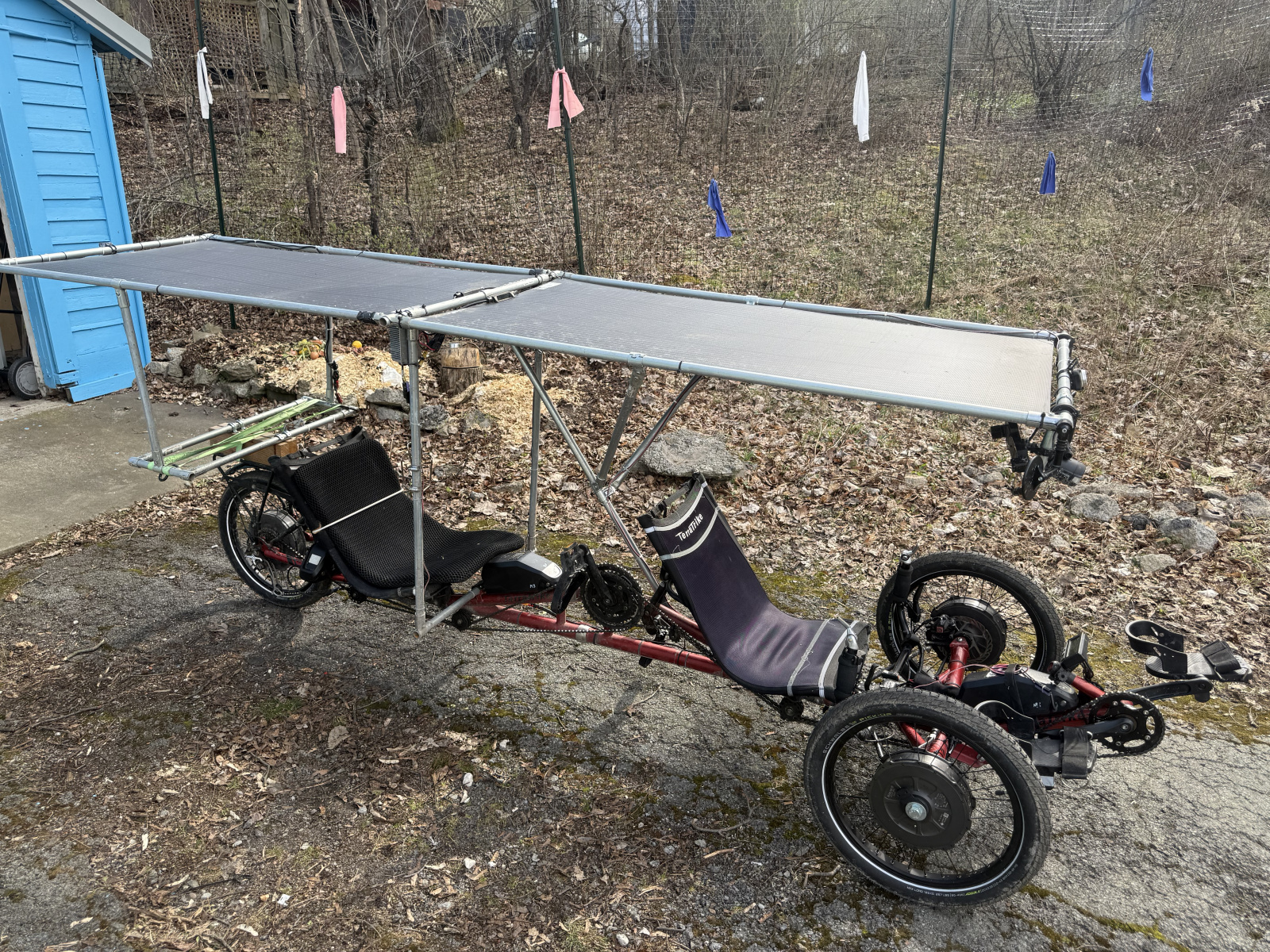
Check out this three wheel drive solar powered recumbent tandem here.
Should I install an electric motor on one or both front wheels?
Most of the time people convert both front wheels for a symmetric drive solution. But that does add substantial cost and weight over a single motor drive.
Running a single front hub motor is also possible and less unnatural as it may seem. Depending on the particular steering geometry of the trike this can require a small counter steering force on the handlebars when you power the motor or do regen.
You can see if that will be an issue or not on your particular trike by riding fast and then coming to a stop braking with just one side, and see how much or little that makes the handlebars want to steer. The motor power on one side will have a similar effect but in the opposite direction. If it’s totally tolerable then a single motor will be fine, while if you find that the steering moment is undesirable then you are best to stick with the more symmetrical 2WD.
What motor power do I need for hills, touring or carrying extra weight?
This is a great question with a big ‘it depends’ answer. First and foremost it is not motor power that determines what you can do, but motor thrust. Motor thrust is a function of the torque output of the motor and the diameter of the wheel. A smaller diameter wheel provides more thrust for the same motor.
20” Wheel: Standard motor is fine for individuals and even cargo on hills. Rarely an issue.
26”-29” Wheel: Fine for individuals on hills, but may be strained with cargo on hills depending on total weight and % grade (simulator has all the results). Max45 motor or dual front motors is sometimes required.
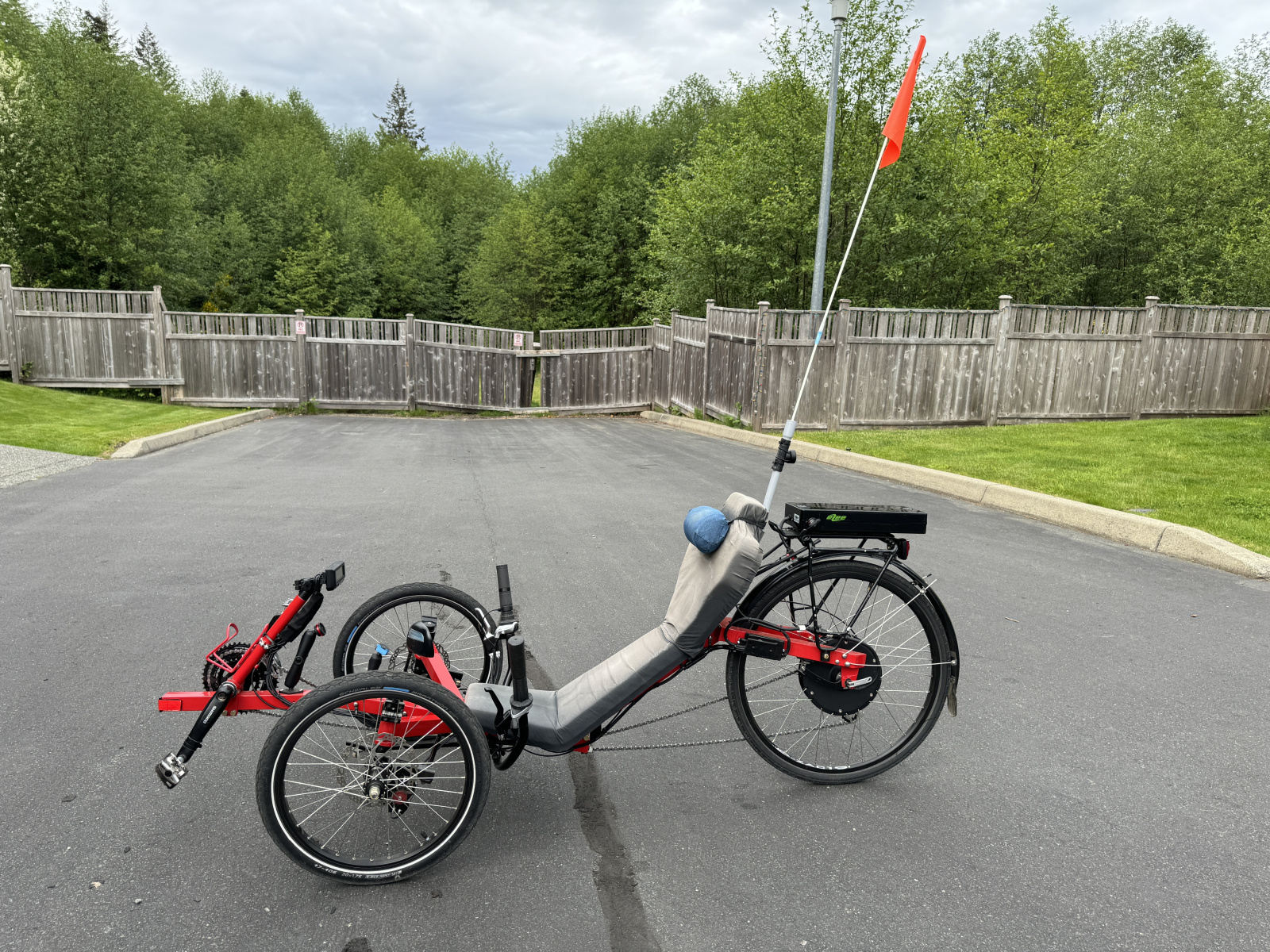
Check out this electric tandem trike conversion story here.
How fast will my recumbent trike go after conversion?
Speed is one of the most frequently featured conversion-kit FAQ questions. For Grin’s kit, performance depends on the motor winding, wheel size, battery voltage, load and controller configuration.
Grin has the most customizable and well documented performance specs to match your application. Our standard kits are available both as Class2 (20 mph) speed option by using a 36V battery pack, or as a class3 (28mph) option with a 48V battery pack.
But other winding choices and battery voltages are available for even slower or faster setups if desired. And the top speed can always be further limited by the motor controller or the display to achieve strict compliance with the limits of any local jurisdiction.
What battery do I need, and how far can I ride on one charge?
Grin kits are compatible with almost any 36V to 52V ebike battery packs. On tadpole trike conversions most customers choose to install a downtube style battery on the boom tube using our triple bob battery anchor. The battery is narrow enough not to interfere with pedaling and leaves the rear rack free for carrying cargo. However, it’s also possible to mount the battery on a rear rack or even under the seat using appropriate mounting brackets if the boom tube is not ideal. Terracycle also has a nice collection of trike-specific battery platforms ( https://t-cycle.com/en-ca/collections/battery-mounts?srsltid=AfmBOorYOqRkI6f17CtvSxl9BFFw5freh17QJY7HocMVEFnjy4vAG7ZU )
As for the range you get on a charge, that simply depends on the size of the battery and how heavily you use it. Tadpole trikes can usually achieve better range and mileage than upright bicycles because of the improved aerodynamics of the recumbent riding position, with 8 wh/km being a typical figure for 20mph speeds compared to 10 wh/km of a regular bike. At that consumption level, you can expect
36V 15Ah battery = 540 watt-hours = ~67km ( 42 miles)
48V 21Ah battery = 1000 watt-hours = ~125km ( 78 miles)
Heavier power usage from going faster or pulling loads will proportionally decrease this range, and in a worst case where you are not pedaling much and going fast the range would be about half of that figure.
Will the motor work with my wheel size, cassette and existing gears?
Grin has a range of rim offerings from 20” to 29” in all different widths, and our all-axle hub motor supports both Shimano HG mountain and road cassettes (7-11 speed), as well as the high-end SRAM XD and XDR cassettes for wide range 1x drivetrains. That makes it one of the most versatile ebike motors on the market. You can purchase a motor already laced into the wheel, or purchase a motor independently and lace the spokes yourself.
Can I install the conversion kit myself, or do I need a bike shop?
We highly recommend installing the kit by yourself or having a mechanically minded friend or family member do it. This gives you intimate familiarity with how the components go together and makes you more adept at any field service or troubleshooting issues that might arise. You do not need any specialized electrical knowledge or electronics tools to do the installation as all electrical connections are just plug and play.
What you do require is a degree of mechanical aptitude around bicycles with familiarity in normal bicycle stuff like disk brakes and derailleurs and tire swapping. If that’s not you, then seek someone who is. Details around the torque arm and frame clamp are particularly important to follow.
Grin has a detailed user manual for the all-axle motor, and several videos covering the installation of our regular all-axle kits and the larger Max45 kits.
Some specialized and open-minded bike stores will offer conversion services and can do an excellent job as well. But many (if not most) bike shops have a strict policy of not touching electronic drives or aftermarket ebike upgrades and will only service ebikes that they have sold. They may say this is for insurance reasons, but more frequently it’s because of previous bad experiences with lower quality ebikes and kits on the market.
We supply the controller and electronics preconfigured for settings that work well together. Advanced users have the ability to use our phaserunner software suite and further tweak or optimize the motor and assist characteristics if they want, but for most people this is not required.
Does the kit have pedal assist, a throttle, regenerative braking and reverse?
Recumbent riders often compare how the assist is activated and whether it feels natural. Grin’s rear kit offers torque-sensing assist, optional throttle control, regenerative braking and reverse functionality.
Grin’s rear All-Axle kit comes with all of those things. The motor has an integrated torque and cadence sensor built-in, and supports bidirectional throttles and ebrakes as well. This gives the best of all control modes at your disposal
- Pedal forwards for smooth torque assist, with the automatic assistance level set up the up/down buttons on the display
- Pedal backwards for optional foot controlled regenerative braking. Provides a quick and intuitive way to slow down without even touching the brake levers
- Throttle forwards any time you want manual control of the motor power. Especially useful for accelerating fast off-the-line or for short bursts of power when you have pedal assist turned off
- Throttle backwards for fully modulated regenerative braking.
- Throttle backwards from a stop and you can now power the motor in reverse, up to a preset maximum reverse speed
Although it is possible to run the system without a throttle, we always recommend still having a throttle installed just in case. It can provide a great back-up way to control the bike if ever there is an issue with the integrated torque sensor or display, and it also makes troubleshooting steps much easier when you can just activate the motor via the throttle.
There is also an option to activate the regenerative braking through either a digital or analog ebrake sensor, allowing the action of squeezing the mechanical brakes to engage regen. With the advent of bidirectional throttle control we find this mode mostly redundant, but for those who prefer it it remains an option too.
What is the total cost to convert my recumbent trike?
Expect to spend between $1800-$3500 on a high end Grin conversion kit for your trike, with most of that cost variability coming down to the battery choice and extra accessories. All the exact pricing shows up in your cart as you select the different options.


